Occupant and Asset Safety
Identifies deterioration, distress, and risk indicators before they escalate into dangerous failures.
Structural failure is one of the most catastrophic and preventable industrial disasters.
Whether you manage an aging factory building, an industrial chimney, a cooling tower, a warehouse, or an infrastructure project, a periodic structural audit by qualified structural engineers provides the evidence needed to ensure occupant safety, regulatory compliance, and asset longevity.
In Maharashtra, structural audits of buildings over 30 years old are mandated by MCGM and municipal authorities. Uniquo's structural auditors are qualified structural engineers who combine visual examination with NDT techniques and structural analysis to deliver comprehensive, defensible structural health reports.
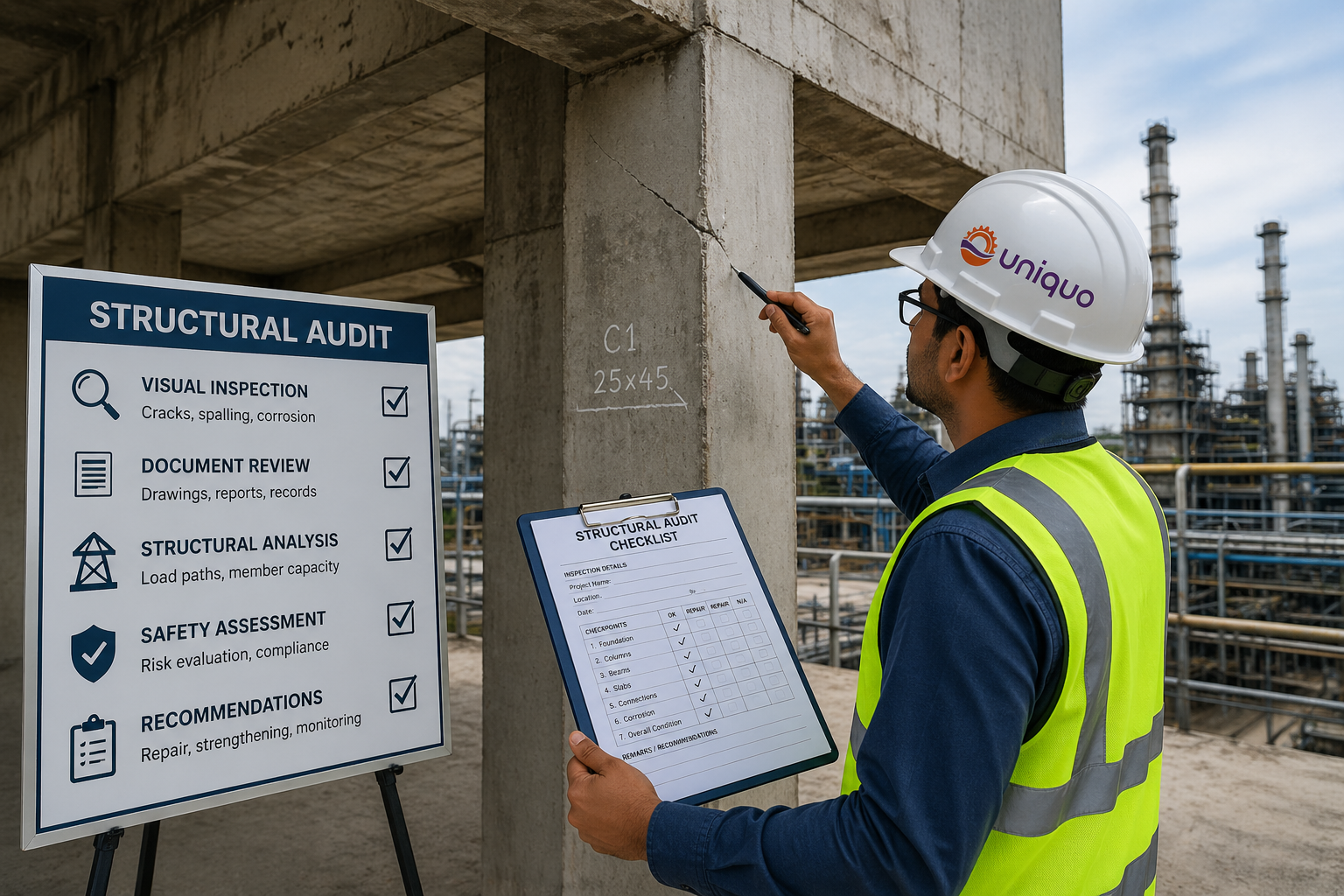
Structural audits provide owners, engineers, and compliance teams with a factual basis for repair planning, continued safe use, redevelopment decisions, loading review, and statutory reporting.
Identifies deterioration, distress, and risk indicators before they escalate into dangerous failures.
Supports statutory audit requirements, including mandatory audit regimes for aging structures.
Provides a sound engineering basis for rehabilitation, redevelopment, and enhanced loading decisions.
Our structural audit scope includes existing structures, special-purpose industrial assets, and buildings undergoing change of use or redevelopment.
RCC and steel-framed industrial buildings used for production, process, and warehousing operations.
Vertical industrial structures exposed to heat, weathering, and long-term operational stress.
Cooling towers and elevated water tanks requiring periodic condition and durability assessment.
Storage systems where condition, loading, and structural performance directly affect safe use.
Marine-exposed structures affected by corrosion, impact, and aggressive environmental conditions.
Intermediate structural systems and platforms used for access, storage, or production support.
Rapid and detailed structural audit support following seismic activity or suspected damage.
Audit support for structures proposed for increased loading or modified operational use.
Buildings being evaluated for redevelopment, rehabilitation, continued use, or demolition decisions.
These methods support a stronger understanding of concrete integrity, reinforcement condition, cover adequacy, durability exposure, and the need for further engineering intervention.
Schmidt hammer testing used to assess surface hardness and indicative concrete strength condition.
UPV testing used to evaluate concrete quality, homogeneity, and possible internal discontinuities.
Cover meter or GPR-based mapping to identify reinforcement position and cover distribution.
Measurement of corrosion activity risk in reinforced concrete elements.
Phenolphthalein indicator-based testing to assess carbonation front penetration.
Concrete core extraction, laboratory testing, and chemical analysis where deeper material evaluation is needed.
Connect with UNIQUO for structural audits supported by qualified engineers, field examination, NDT methods, and defensible structural health reporting.