
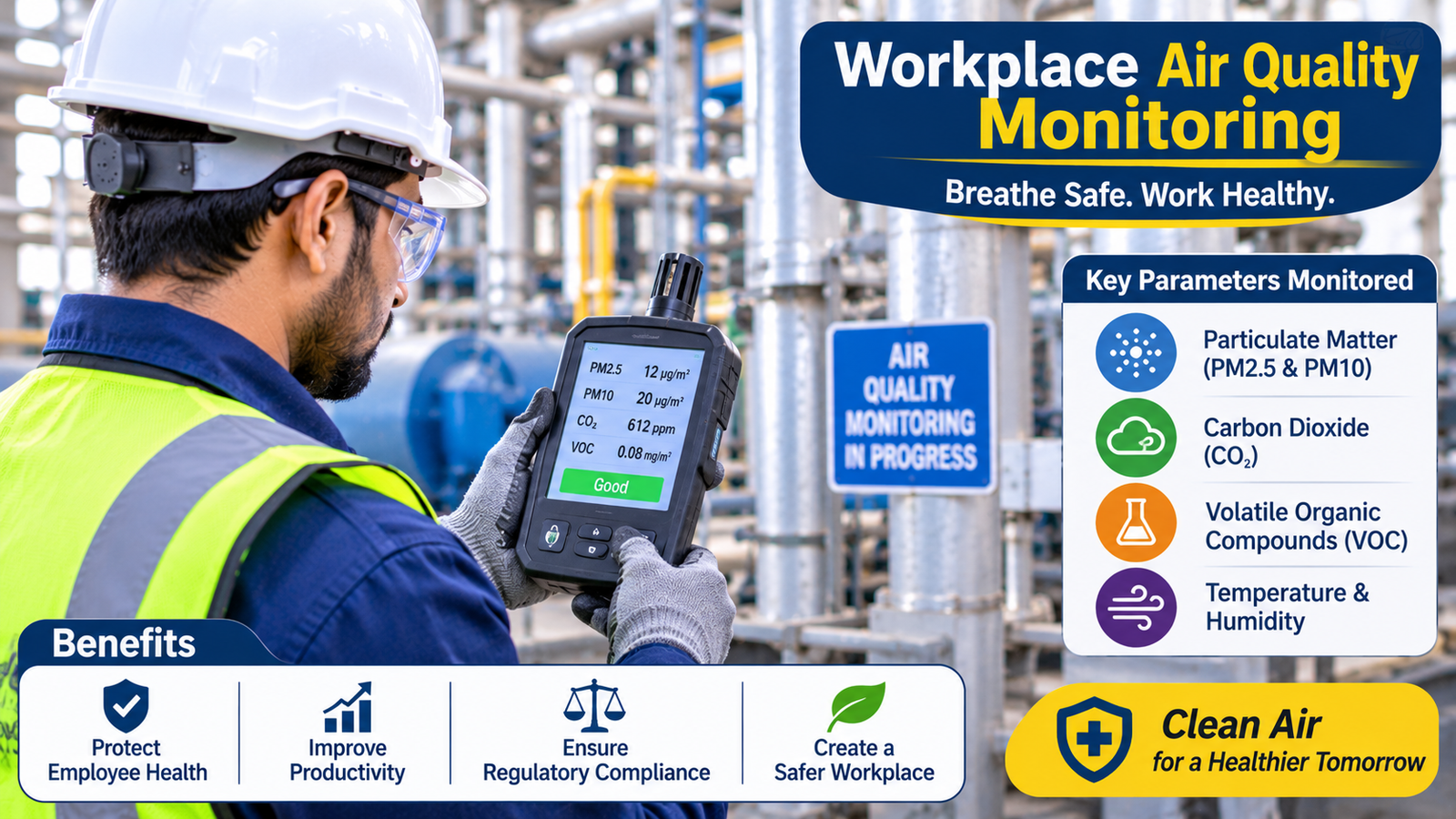
Air quality is an important part of a safe working environment. In industrial facilities, processes such as welding, cutting, painting, material handling, combustion and chemical use can release airborne contaminants. Some hazards are visible; others cannot be detected reliably by sight or smell. Workplace air quality monitoring provides measured information that can help employers understand exposure conditions and decide whether controls are working as intended.
Monitoring is not a substitute for eliminating a hazard or controlling it at source. It is one part of an occupational health and safety programme that should begin with process knowledge and a suitable risk assessment.
What is workplace air monitoring?
Workplace air monitoring is the planned measurement or sampling of airborne substances or environmental parameters in a work area. The approach depends on the hazard and the question being investigated. It may involve personal sampling in a worker’s breathing zone, fixed-location sampling, direct-reading instruments or laboratory analysis of collected samples.
Why industrial facilities monitor air
Identify potential exposure
Monitoring can help determine whether workers may be exposed to dust, fumes, gases, vapours or other airborne agents during a task or shift. Personal and area samples answer different questions, so the sampling strategy should reflect the work pattern and exposure pathway.
Check the effectiveness of controls
Results may help assess local exhaust ventilation, enclosure, process changes, housekeeping or other control measures. Measurements before and after a change can provide evidence about whether conditions improved, provided the sampling conditions are comparable.
Support health and safety decisions
Reliable results can inform risk assessments, control priorities, worker information and follow-up monitoring. Where a regulatory or occupational exposure limit applies, the correct substance, averaging period, sampling method and jurisdiction must be identified before interpreting a result.
Common workplace air contaminants
- Dust and particulate matter: generated by cutting, grinding, crushing, handling powders and other processes.
- Welding fumes: complex airborne mixtures produced during welding, influenced by the base metal, consumables, coatings and process.
- Gases: may arise from combustion, process operations, confined or poorly ventilated areas and chemical reactions.
- Vapours: may be released from solvents, coatings, fuels, cleaning agents and other volatile substances.
- Fibres and specialised agents: require hazard-specific identification and appropriate sampling and analytical methods.
The presence of a contaminant does not by itself describe the risk. Exposure depends on concentration, duration, route of entry, task, controls and the properties of the substance.
How is an air monitoring programme designed?
1. Understand the process
Review raw materials, safety data sheets, process steps, equipment, operating conditions, shift patterns and tasks that may generate airborne contaminants.
2. Define the monitoring question
Decide whether the purpose is baseline characterisation, personal exposure assessment, investigation of a complaint, evaluation of controls or follow-up after a process change.
3. Select the sampling approach
Choose personal or area sampling, direct-reading or laboratory methods, sample duration and locations based on the substance and applicable method. Sampling equipment must be suitable and appropriately calibrated or checked.
4. Record site conditions
Document the process, task, location, duration, production conditions, ventilation status, weather where relevant and any unusual events. Context helps prevent results from being interpreted without understanding how the sample was collected.
5. Interpret results carefully
Compare results only with an appropriate reference value for the substance, jurisdiction, sampling period and method. A short-duration area reading should not be treated as equivalent to a full-shift personal exposure measurement.
6. Act on findings
Prioritise elimination or substitution where feasible, then engineering controls such as enclosure and local exhaust ventilation, followed by administrative controls and suitable personal protective equipment. Verify that controls remain effective.
What should an air monitoring report include?
Reports should identify the site and process, monitoring objective, contaminants assessed, sampling locations or workers, dates and durations, methods and equipment, calibration or quality checks, laboratory details where applicable, results, comparison criteria, limitations and recommendations. Personal information should be handled appropriately and shared only with authorised recipients.
Common mistakes to avoid
- Sampling without first identifying the process hazards and monitoring objective.
- Using an area reading to make unsupported conclusions about an individual worker’s exposure.
- Comparing measurements with an unrelated limit or averaging period.
- Ignoring production conditions, ventilation changes or unusual events during sampling.
- Treating monitoring as a one-time activity even after processes or controls change.
How UNIQUO supports air monitoring
UNIQUO lists air monitoring within its industrial testing services. The monitoring scope should be tailored to the process, substances of concern, site conditions and applicable assessment criteria. Share the process details and the question you need the monitoring to answer so the appropriate approach can be discussed.
Learn more about UNIQUO air monitoring services or submit your requirement through Contact Us.
Conclusion
Workplace air monitoring turns an invisible hazard into information that can guide better decisions. When the sampling strategy is matched to the process, measurements are interpreted against appropriate criteria and findings lead to effective controls, monitoring can strengthen an organisation’s occupational health and safety programme.